

In a market racing toward AI-driven outcomes, organizations are discovering a simple truth: AI is only as reliable as the data behind it.
For years, governance has often been treated as a passive function — metadata in a catalog, rules defined in isolation; data issues addressed reactively. That approach doesn’t hold up in an AI-first world.
It’s time for governance to move from passive oversight to active stewardship — embedded, accountable, and operational at the speed of the business.
Data now moves across teams, platforms, and AI-driven processes at a pace and scale that makes traditional passive governance insufficient. Ensuring data trust requires active validation by domain experts, structured accountability, and outcome-aligned remediation. Qlik is announcing general availability of Data Stewardship in Qlik Talend Cloud (Premium and Enterprise) — a new capability designed to operationalize data trust.
Why does data stewardship matters?
Because in AI-driven environments – lack of data trust can quickly elevate the risks.
Take for example, a healthcare network uses AI to prioritize outreach to high-risk patients. The system flags thousands of records with missing allergy information, but it cannot act on what it means for the business. Are the allergies missing, or stored in another system? Is it safe to move forward with outreach, or should it pause until more information is gathered?
A data steward reviews the situation, confirms the business impact, assigns ownership, and decides whether the data is safe to use. That human judgment keeps the AI workflow both responsible and reliable.
Data Stewardship in Qlik Talend Cloud accelerates governance initiatives, moving from passive to active and collaborative workflows — aligning business, data, and AI teams around a shared, trusted view of data.
Why you should use data stewardship in Qlik?
Accelerate resolution with sprint-based workflows
Traditional governance processes are often ad hoc and reactive. Issues are discovered late, ownership is unclear, and remediation cycles stretch across weeks or months.
Data Stewardship introduces sprint-based workflows that replace fragmented processes with structured execution that is assigned, prioritized, tracked.
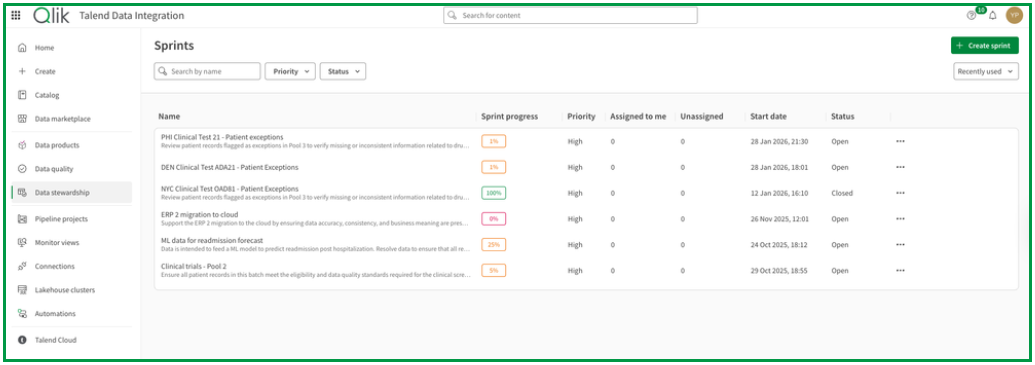
Clear ownership and SLAs bring accountability across domains. Instead of firefighting, teams move toward proactive stewardship — reducing remediation cycle times and improving transparency.
Standardize Trust with Pervasive Data Quality
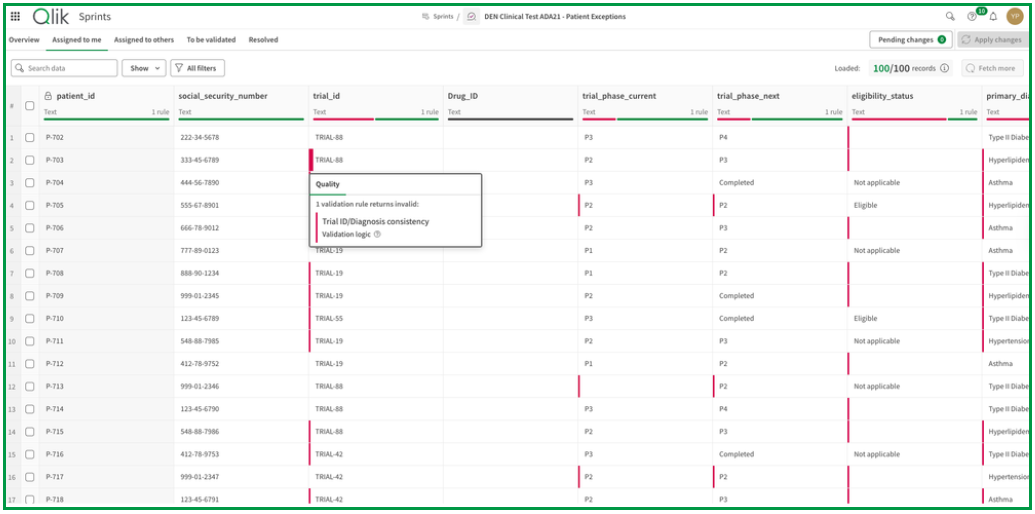
Trust should not depend on isolated pure rule-based checks or tribal knowledge. Data stewardship makes data quality into a continuous, accountable practice. Instead of treating quality as a one-time check, embedded quality controls and observability signals continuously monitor, measure, and surface issues across the data lifecycle — driving proactive improvement rather than reactive fixes.
Bring domain experts into the trust loop
Automated systems are powerful — but they cannot infer business meaning on their own.
Data Stewardship brings business and data stewards directly into validation and remediation processes. Domain experts collaborate to validate flagged issues, assess business impact, apply domain-context specific remediation, and confirm resolution.
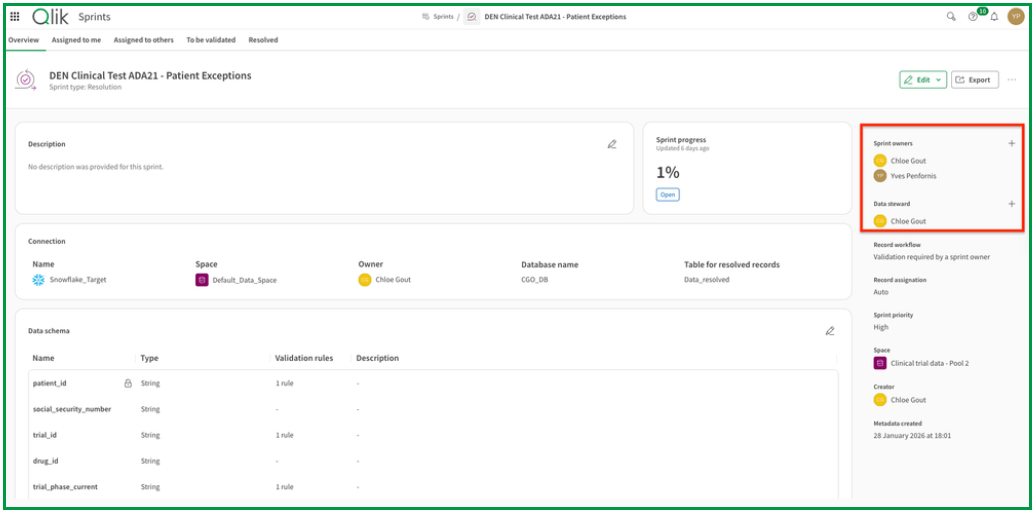
This human-in-the-loop model ensures that decisions reflect real-world business semantics — not just technical correctness. The result is higher reliability, stronger alignment, and more relevant data for downstream consumption including AI and agentic use-cases.
Run stewardship operations where data resides
Moving data across tools just to manage governance adds complexity and risk.
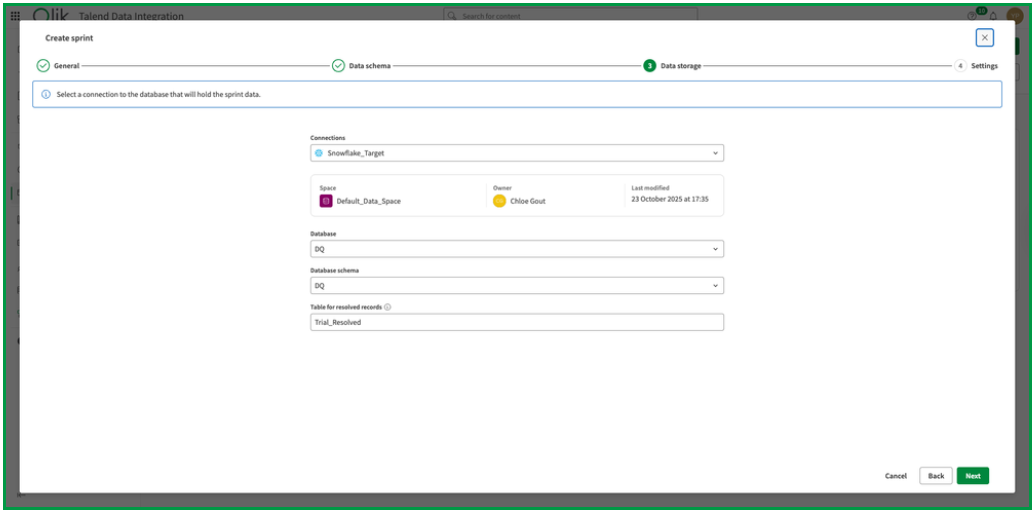
Data Stewardship operates directly where the data lives. By running stewardship workflows in place, organizations can avoid unnecessary data movement leveraging their existing data infrastructure (such as Snowflake), minimize operational overhead, and reduce security and compliance exposure.
Conclusion
Data quality and governance is a team effort, and data stewardship acts as the connective layer linking business users, data engineers, and AI teams. It creates clearer alignment, accelerates decision making, and strengthens organizational confidence — especially as business users drive data-powered initiatives and adopt AI.
Article source: qlik.com.
For information about Qlik™, click here: qlik.com.
For specific and specialized solutions from QQinfo, click here: QQsolutions.
In order to be in touch with the latest news in the field, unique solutions explained, but also with our personal perspectives regarding the world of management, data and analytics, click here: QQblog !